Whether you’re building a new home, renovating a kitchen, or fitting out a commercial space in Mauritius, choosing the right cement is one of the most important decisions you’ll make. Get it wrong and you risk cracking, weak structures, or costly repairs. This guide explains the main cement types available in Mauritius, what each one is used for, and how to pick the right one for your project.
Why Cement Choice Matters in Mauritius
Mauritius has a tropical climate with high humidity, salt air in coastal areas, and cyclone-season rain. These conditions place specific demands on cement and concrete — particularly when it comes to moisture resistance, sulphate resistance, and long-term durability. Using the wrong cement type for your application can lead to premature deterioration, cracking, and structural failure.
The Main Cement Types Available in Mauritius
Ordinary Portland Cement (OPC)
The standard general-purpose cement used in most construction projects. OPC gives high early strength — ideal when you need formwork removed quickly or when working to a tight programme. It is suitable for most above-ground structural work including columns, beams, slabs and walls.
Best for: General structural concrete, foundations on non-aggressive ground, floor screeds, render, blockwork mortar.
Blended Cement (OPC + Fly Ash or Slag)
Blended cements replace a proportion of clinker with supplementary materials such as fly ash or ground granulated blast furnace slag (GGBS). This improves long-term durability, reduces heat of hydration and — importantly for Mauritius — improves resistance to sulphate attack and chloride penetration. The trade-off is slower early strength gain.
Best for: Foundations in aggressive ground, marine and coastal structures, large pours where heat build-up is a concern, reinforced concrete in humid or salt-air environments.
Masonry Cement
Masonry cement is specifically formulated for mortar applications — laying blocks, bricks and stone. It contains lime and workability aids that make it easier to apply and give better bond with masonry units. It should not be used for structural concrete.
Best for: Blockwork mortar, pointing, render coats, general masonry work.
Cement Brands at QBM Hardware
QBM Hardware stocks the Cementis range — including CMIXÉ and Baobab products — covering the main cement and dry mix products needed for construction and renovation in Mauritius.
Cement and dry mix products at QBM Hardware
| Product | Brand | Best for |
| CMIXÉ Structural Cement | Cementis | Columns, beams, slabs, foundations |
| CMIXÉ Masonry Mix | Cementis | Blockwork mortar, pointing |
| Baobab Cement | Cementis | General construction use |
| Baobab Dry Mix | Cementis | Screeds, render, small repairs |
How to Choose the Right Cement for Your Project
Foundation Work
For foundations in normal ground conditions, OPC-based structural cement such as CMIXÉ is appropriate. If your site has aggressive soil conditions — high sulphate content, waterlogged ground or proximity to the sea — specify a blended or sulphate-resisting cement. Always ask your structural engineer or architect to specify the concrete mix design for foundation work.
Floor Screeds
Floor screeds require a sand-cement mix that is workable, durable and resistant to surface wear. A standard mix of 1 part cement to 4 parts sharp sand by volume is typical for a bonded screed. Pre-mixed dry screed products eliminate the need to measure on site and give more consistent results — available at QBM Hardware.
Blockwork and Mortar
For laying concrete blocks, use a masonry mortar mix — 1 part cement to 5–6 parts building sand. Using structural cement for mortar creates a mix that is too strong and too rigid, which can cause blocks to crack rather than joints to flex. Masonry cement or pre-mixed mortar products are the correct choice.
Rendering and Plastering
External render in Mauritius needs to withstand heavy rain, UV exposure and salt air. A 1:4 or 1:5 cement:sand mix with a plasticiser gives good workability and durability. In coastal areas, use a blended cement for improved salt resistance. Apply in two coats — a scratch coat and a finish coat — for best results.
How Much Cement Do You Need?
Estimating cement quantities correctly saves money and avoids delays. Use these rules of thumb as a starting point — always round up to the nearest bag to allow for waste.
Cement quantity guide
| Application | Mix ratio | Cement per m³ |
| Structural concrete (C25) | 1:2:4 | ~7 bags (50kg) |
| Floor screed | 1:4 | ~6 bags (50kg) |
| Blockwork mortar | 1:5 | ~5 bags (50kg) |
| External render | 1:4 | ~4 bags per 10m² |
Always buy slightly more cement than your calculation suggests. Running short mid-pour causes cold joints which weaken the structure. A spare bag costs less than a structural repair.
QBM Hardware, Phoenix Mauritius
Tips for Working with Cement in Mauritius’s Climate
- Work early in the morning during hot weather — high temperatures accelerate cement setting and reduce workability. Avoid pouring concrete in direct midday sun.
- Cure your concrete properly — keep freshly placed concrete moist for at least 7 days by covering with wet hessian or plastic sheeting. In Mauritius’s heat, inadequately cured concrete loses strength rapidly.
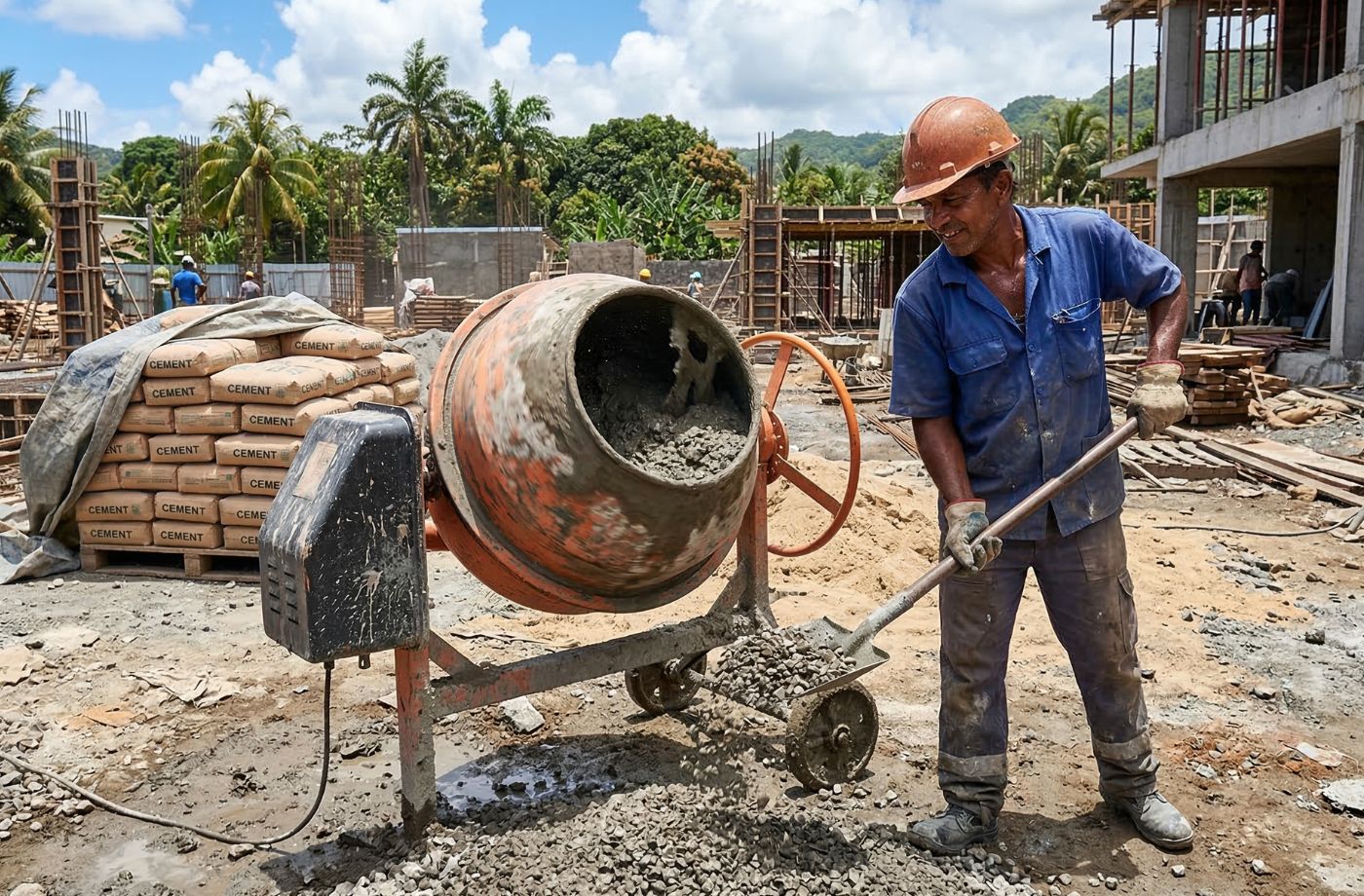
- Store cement off the ground and away from moisture. Even a single damp night can cause bags to set solid. Use pallets and store in a covered area.
- Don’t add excess water to improve workability — it reduces strength. Use a plasticiser instead if needed.
- In coastal areas, use blended or sulphate-resisting cement and ensure adequate concrete cover over reinforcement to protect steel from chloride-induced corrosion.
Buy Cement at QBM Hardware, Phoenix
QBM Hardware stocks the Cementis CMIXÉ and Baobab ranges at 59 Royal Road, Phoenix. Whether you need a single bag for a small repair or a bulk order for a construction project, our team can advise on the right product and quantity for your job.
QBM Hardware — 59 Royal Road, Phoenix
Mon–Fri 7:30am–5pm | Sat 7:30am–12pm
Call (+230) 686 6198 or WhatsApp (+230) 5255 1799 for bulk orders and pricing.
Frequently Asked Questions
How long does cement last in storage in Mauritius?
In Mauritius’s humid climate, unopened cement bags stored correctly off the ground and away from moisture will last 3 months. After that, moisture absorption causes lumps to form and the cement loses strength. Always check bags before use — if you can crush lumps easily by hand the cement is still usable, but hard lumps indicate the cement has begun to hydrate and should not be used for structural work.
Can I use beach sand for mixing concrete in Mauritius?
No. Beach sand contains salt which causes corrosion of steel reinforcement and weakens the concrete mix. Always use washed river sand or quarry sand from a reputable supplier. This is particularly important in Mauritius where beach sand is readily available but entirely unsuitable for construction use.
What is the difference between cement and concrete?
Cement is the binding agent — the grey powder that reacts with water to create a paste that hardens. Concrete is the finished material made by mixing cement with aggregates (sand and gravel) and water. Mortar is cement mixed with sand only, without coarse aggregate, used for jointing and rendering.
Does QBM deliver cement in bulk?
Yes — QBM Hardware can arrange delivery of cement and building materials across Mauritius. Contact us on (+230) 686 6198 or WhatsApp (+230) 5255 1799 to arrange a bulk order and confirm current stock and pricing.